
In our last post, we mentioned that we set loose a group of Designers, Producers, and Ops managers on Roblox with nothing but an idea and a Claude login.
While the resulting games were impressive, and in some cases, surprisingly functional; the real experiment wasn't happening in the code. It was happening in the room. We didn't do this to become an "AI-first agency" (which sounds a bit too much like a PowerPoint slide for our liking). We did it to see if we could stop being afraid of the "robot uprising" by actually shaking hands with the robots.
Demystifying the Monster
There’s a lot of talk about AI taking over. It’s usually framed as a looming, sleek, inevitable force.
However, after two weeks of working with it, our team’s description of AI was a little less... cinematic. Words like "stubborn," "confident," and "confused" came up quite a lot.
The Stats (The Human Ones)
We tracked how everyone felt before and after the two-week sprint. We weren't looking for "productivity gains" or "synergy",we were looking at the "Fear Factor."
Over all our participants a majority felt way less afraid about AI actually replacing their job after the experience
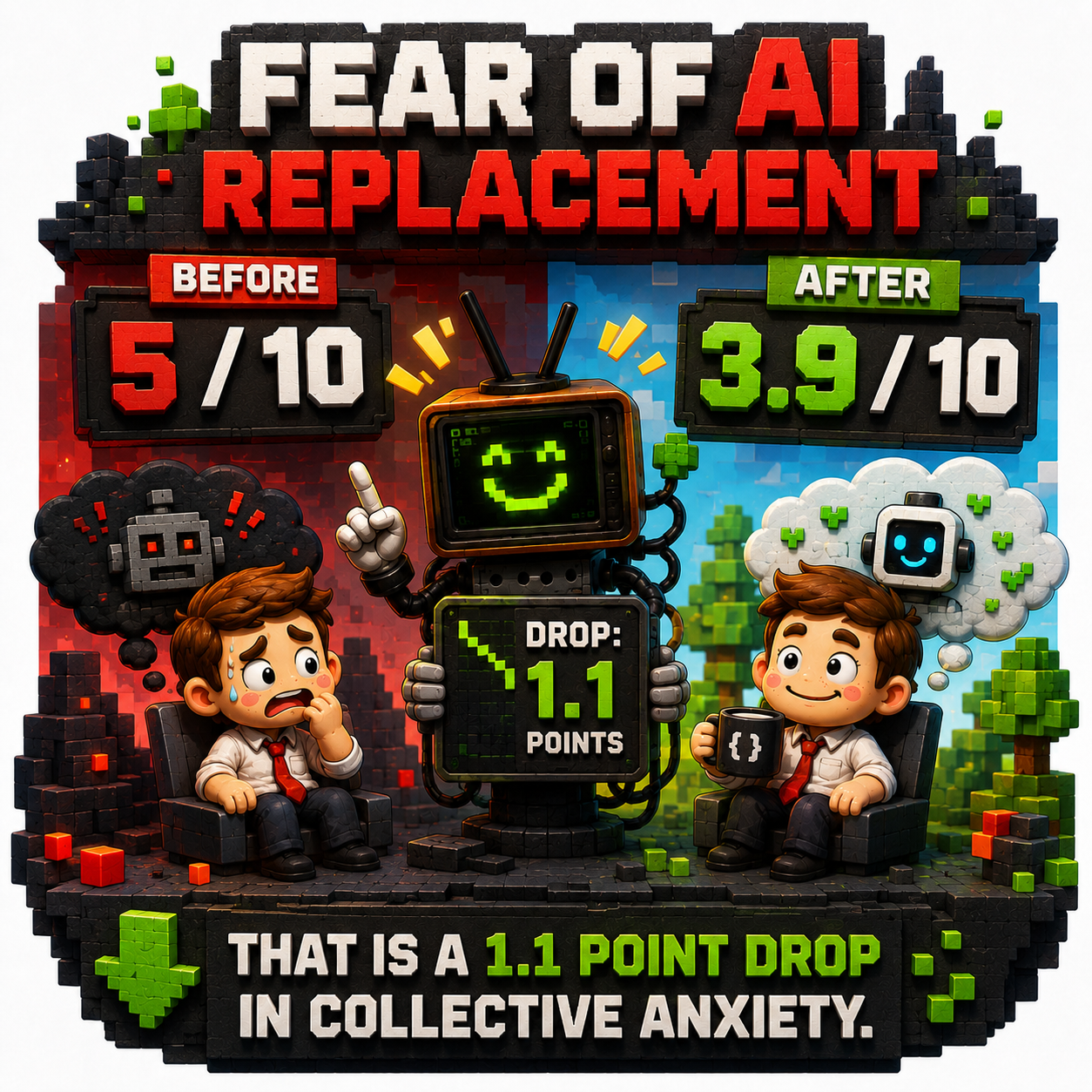
Fear of AI Replacement (Before): 5 / 10
Fear of AI Replacement (After): 3.9 / 10
That is a 1.1 point drop in collective anxiety.
It turns out that the best cure for AI-induced dread is to actually use it. It’s hard to be terrified of something that politely hallucinates a solution to a problem it doesn’t fully understand. Once you realise the AI is more like an over-enthusiastic, slightly eccentric intern than a replacement for your brain, the world feels a bit more manageable.
Empathy Through Technology
One of the most interesting consequences of the Jam was how it blurred the lines between our desks.
By removing the need to manually write every line of Lua, we saw Producers and Designers stepping into roles they usually only observe from a distance. When a non-developer spends an hour trying to prompt a functional multiplayer mechanic, they aren't just "making a game" - they’re gaining a sudden, vivid empathy for why their engineering colleagues sometimes stare quietly into their coffee for long periods of time.
It turns out that AI is a great leveler. It doesn't replace the expert; it just allows the expert to focus on the craft while the AI handles the "grunt work" (or at least tries to, before it gets distracted).
The Verdict
The Koffeejam taught us that AI is a brilliant amplifier, but it’s a terrible pilot. It’s a tool that allows us to walk in each other's shoes, provided we’re prepared for the occasional blister. We’ve emerged from the jam 1.1 points more relaxed about the future, which - in this industry - is quite a result.
Coming up next
We’re going to stop talking about feelings and start looking at the actual games. We’ll meet the humans who built them, find out which bits were "magic" and which bits made them want to throw their laptops into the Thames.
Stay tuned. It’s time to see what happens when the prompts actually work.