
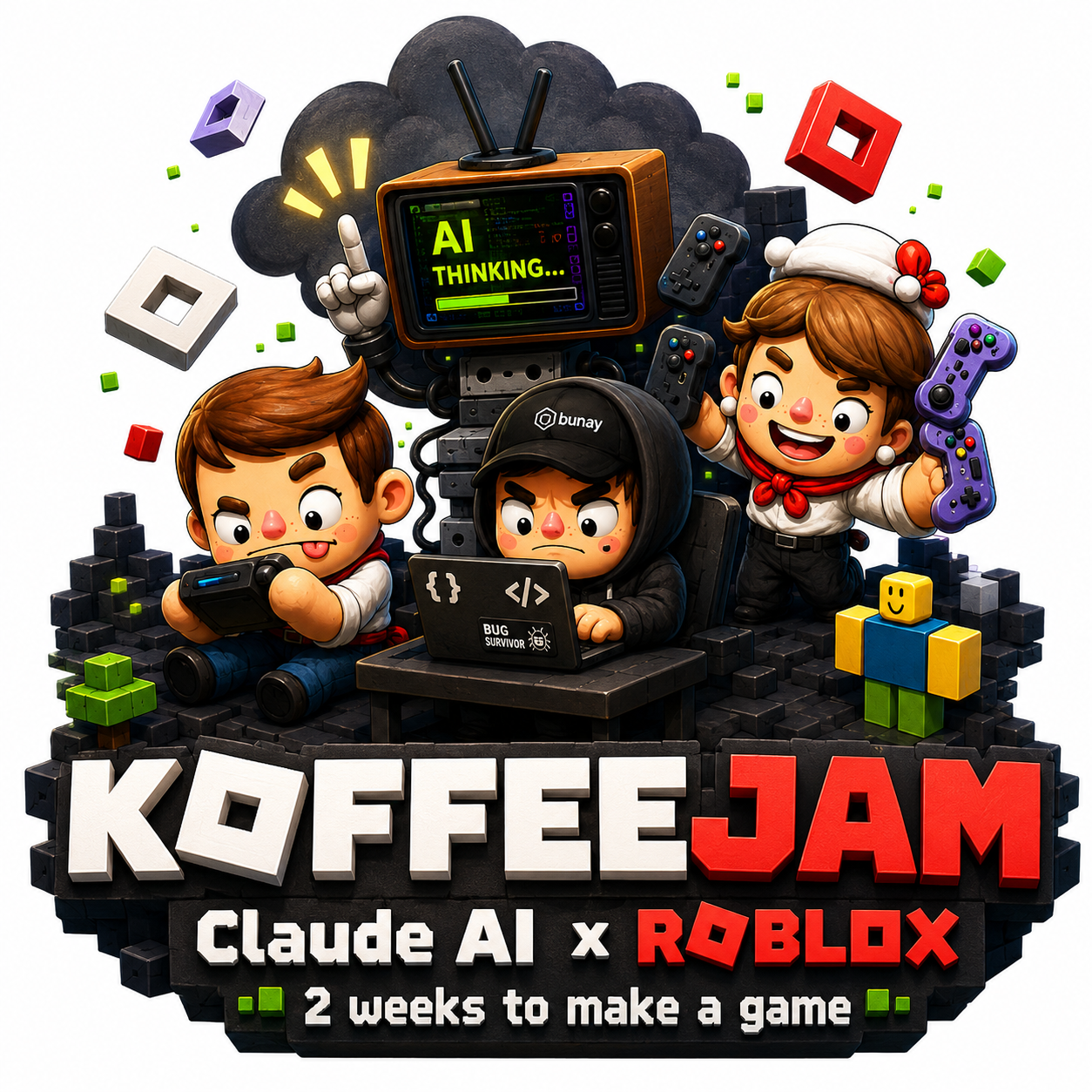
At Koffeecup, we’ve always been quite fond of a bit of experimentation.
Recently, we decided to point that curiosity toward the intersection of AI and User Generated Content (UGC).
We called it the KOFFEEJAM.
The premise was straightforward: use AI prompting tools to bring a game idea to life.
You didn’t need to write code.
You didn’t need to know what a shader was (honestly, does anyone?).
You just needed an idea and the willingness to type things at a computer until something interesting happened.
So, a normal Tuesday, really.
We settled on Roblox for the experiment. It’s a sensible choice because it allows you to bypass the "making things look pretty" phase and get straight into the "making things actually work" phase. (Which is usually where the trouble starts.)
The brief was simple: create a stable, multiplayer game for up to eight players using an AI-first approach. We provided everyone with Claude access and a polite request to see how far AI could actually accelerate real product development.
Who was invited?
Everyone. Designers, developers, ops -if you work at Koffeecup, you were in. This was the interesting bit: seeing how AI could prop up our various weaknesses, whatever they happened to be. We wanted to see what happens when you remove the traditional barriers to entry.
If you got stuck, someone would unstick you. If it felt weird, that was fine; it was new for most of us. No one was being graded (alright, maybe there was a final ranking with votes and prizes for the winners), though we did suggest starting small. The best ideas usually start as the smallest ones, before they inevitably grow into something that makes a developer stare quietly into their coffee."
The Reality Check
The goal was to test if Claude could handle the heavy lifting in a real-time environment. We wanted to move past the hype and see what the actual day-to-day of AI-assisted dev looks like.
As it turns out, the most fascinating discovery wasn’t how smart the AI was, but how politely it can be wrong. There is a certain art to an AI finishing a task, sending a very professional "I’ve completed that for you" message, and then handing over a script that does absolutely nothing.
The Aftermath
We’ve now emerged from the two-week sprint with a handful of games that actually work, several that nearly work, and a few that seem to defy the fundamental laws of physics.
Now, we just have to play them all and vote for a winner.
But the real story isn’t just the games; it’s the awkward dance between the human and the machine. Was it a collaborative duet? Or was it more like trying to move a sofa with someone who is incredibly enthusiastic but has no sense of spatial awareness? (Usually the latter, at least for the first few days.)
Coming up next
In the next few posts, we’ll be meeting the Koffeecupers behind the projects. We’ll be looking at the humans behind the screens, what they actually felt, the bits they found surprisingly easy, and the moments that were genuinely pulling-your-hair-out difficult.
We’ll explore how they found their way to a finished game and what this experience actually taught them about the way they work. It turns out that when you give everyone the power to build anything, things get weird very quickly.
Stay tuned to see how they survived!